A client once described standing in a high-end lingerie boutique while the sales associate searched the entire back room, came up empty, and suggested she "try online." She left without a bra and without an answer. If you've ever wondered what the largest bra size actually is — or whether your measurements even have a proper label — you're asking a question that matters more than most people admit. Understanding the full range of bra sizing is a genuine wellness and lifestyle issue, one that touches comfort, posture, and confidence every single day.

Most women grow up believing that bra sizes run A through D and that anything beyond that is rare or exotic. That belief is wrong, and it costs women years of wearing the wrong size. The cup size alphabet extends well past D, and specialty brands manufacture bras in sizes that mainstream stores have never stocked. The largest bra size isn't some distant anomaly — it's simply a point on a spectrum that the fashion industry has been slow to acknowledge.
This guide covers the full scope of large and oversized bra sizes: what they are, who wears them, how to find your actual fit, how to care for bras at the top of the size range, and how to shop without ending up frustrated. If you've spent years in a bra that almost fits, what follows will shift things.
Contents
What the Largest Bra Sizes Actually Look Like
Bra sizing works on a simple principle: a number for your band, a letter for your cup. The band reflects your underbust circumference, and the cup letter reflects the difference between your full bust and your band measurement. Each additional inch of difference moves you one letter up the alphabet. One inch is an A cup. Two inches is a B. Three is a C, and so on — without any natural stopping point.
In mainstream retail, you'll typically find cups up to DDD or F. Beyond that, most department stores go quiet. But specialty lingerie brands — particularly British and European labels like Panache, Freya, Elomi, and Fantasie — regularly produce bras through K and L cups. Some brands extend to M and N. Custom bra makers work without any upper limit at all. The largest bra size in commercial production sits somewhere around an N cup in standard sizing systems, though the exact letter varies depending on whether you're using US, UK, or European conventions.
The Cup Size Scale in Plain Terms
The table below shows how cup sizes correspond to bust-to-band differences across the most commonly used sizing scales. Note that letter equivalents shift between US and UK systems, which is why international shopping can feel confusing.
| Bust–Band Difference | US Cup Size | UK Cup Size | General Classification |
|---|---|---|---|
| 1 inch | A | A | Small |
| 2 inches | B | B | Small–Medium |
| 3 inches | C | C | Medium |
| 4 inches | D | D | Medium–Full |
| 5 inches | DD | E | Full |
| 6 inches | DDD / F | F | Full |
| 7 inches | G | FF | Large |
| 8 inches | H | G | Large |
| 9 inches | I | GG | Very Large |
| 10 inches | J | H | Very Large |
| 11 inches | K | HH | Extended |
| 12+ inches | L / M / N+ | J / JJ / K+ | Specialty / Custom |
Pro tip: A US DD is equivalent to a UK E cup. If you've been dismissing British brands because the letters don't match what you know, you may be overlooking brands that carry your exact size under a different label.
The Largest Sizes on Record
According to the Wikipedia overview of bra sizing, the world record for the largest natural bust is held by Annie Hawkins-Turner, also known as Norma Stitz, whose measurements have been documented at a 102ZZZ. That falls entirely outside any standard sizing framework — custom construction is the only option at that scale. For most women seeking large-cup support, the practical upper range in specialty retail sits between a G and an N cup, depending on band size. It's a wide range, and there are far more options within it than most people realize.
How to Measure for a Large-Cup Fit
If you've been buying bras based on what the department store carries, or by guessing from the size you wore a decade ago, you are almost certainly in the wrong size. Studies consistently show that most women wear bras with a band that's too large and a cup that's too small — and this error compounds significantly at larger sizes, where the difference between a poor fit and a good one is measured in pounds of unsupported weight.
Taking Your Measurements Correctly
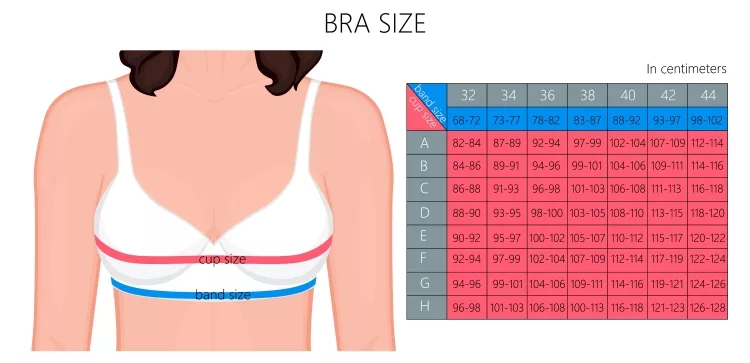
You need two numbers. First, measure your underbust — wrap a tape measure snugly around your ribcage, directly below your breasts. This number, rounded to the nearest even number, is your band size. Second, measure your full bust at its widest point, with the tape parallel to the floor and just loose enough not to compress tissue. Subtract your underbust number from your bust number. That difference in inches gives you your cup size using the chart above.
Warning: Do not add 4 or 5 inches to your underbust measurement. That formula was designed for non-stretch bras from decades past and produces a band that's far too large. Use your actual underbust measurement as your band size.
Sister Sizes and Why They Expand Your Options
Sister sizes are bra sizes that share the same cup volume but use different band numbers. A 34F and a 36E hold identical cup volume — the shape of the cup is the same, only the band length differs. Going up one band size means going down one cup letter to maintain the same volume; going down one band size means going up one cup letter. Knowing your sister sizes triples the styles available to you in any shopping environment, especially when your exact size isn't stocked.
If you need support specifically for larger-busted frames, the guide on best strapless bras for large breasts covers styles and brands engineered to handle heavier cups without losing structural integrity — especially important for warm-weather dressing.
Caring for Large-Cup Bras So They Last
A well-fitting bra in a large cup size is a genuine investment. The engineering required — wider straps, reinforced underwire channels, multiple hook-and-eye closures, boned side panels — costs more to produce. Treating these bras with care means they'll hold their shape and support for far longer than a cheaply constructed alternative ever could.
Washing and Drying
Hand washing in cool water with a gentle detergent is always the safest option. If you use a washing machine, place the bra in a mesh lingerie bag, fasten all hooks before washing so they don't snag other fabrics, and use a delicate or gentle cycle with cold water. Never put a structured bra in the dryer. Heat breaks down elastic fibers and warps underwire permanently. Lay your bras flat on a clean towel or hang them by the center gore — not by the straps — to air dry completely before storing.
Storage That Protects the Shape
Stack bras cup-inside-cup in a dedicated drawer rather than folding one cup into the other. Folding crushes padding and distorts the cup's molded shape over time. If you have multiple bras — which you should — storing them upright in a single file keeps the structure intact. Rotate between at least three bras so each one has 24 hours to recover its elasticity between wears.
Pro tip: Rotating between three bras isn't just a comfort strategy — elastic that gets a full day's rest between wears retains its recovery significantly longer, extending each bra's functional life by months.
Smart Shopping for Full-Cup and Large Bra Sizes
Shopping for a large bra size from a mainstream retailer is often a dead end. Knowing where to look — and exactly what to look for in construction — determines whether you leave with something that works or leave with nothing at all.
Where to Shop
Specialty lingerie brands carry the widest selection of large cup sizes. Panache, Freya, Elomi, Goddess, and Wacoal all produce extensive large-cup lines with real structural engineering. Online retailers with detailed size filters, including HerRoom and Bare Necessities, stock these brands and allow you to filter by exact band and cup size. For women dealing with back discomfort in addition to large cup needs, the guide on best bras for back fat includes back-smoothing styles with wider bands that distribute weight more evenly across the torso.
What to Look For in Construction
In large cup sizes, construction details carry more weight than brand name or aesthetic. Look for wide, cushioned straps — at least three-quarters of an inch wide — that won't dig into your shoulders under real weight. A minimum of three hook-and-eye closures ensures the band stays anchored. Full-coverage or balconette styles with reinforced side panels provide the lateral support that prevents breast tissue from migrating to your underarm. The underwire should follow the full natural curve of your breast and sit flat against the chest wall, not on breast tissue itself.
When to Size Up — and When Your Current Fit Is Fine
Not every bra discomfort signals a sizing problem, but certain signs clearly indicate that you need a larger cup, a different band, or both. Learning to read your bra's fit is a skill — and once you have it, you'll never tolerate a poor fit again.
Signs You Need a Larger Cup
Your cup is too small if the fabric pulls away from your breast and creates gaps at the top, or if breast tissue spills over the top or sides of the cup — sometimes called "quad boob." The underwire sitting on breast tissue rather than the chest wall is a structural red flag. If your straps are doing most of the lifting because the band has stretched out and rides up your back, both the cup and the band are past their useful life. A cup that's even one size too small creates measurable pressure on breast tissue throughout the day.
Signs Your Bra Actually Fits
A properly fitting bra sits flat against your sternum at the center gore with no gapping. The band runs parallel to the floor all the way around — not angled upward at the back. Straps stay in place without digging or slipping when you move naturally. The cups contain all breast tissue without compression or overflow. If all of those conditions are met, your bra fits correctly — regardless of what size is printed on the label.
Frequently Asked Questions
What is the largest bra size available from specialty retailers?
Most specialty lingerie brands produce bras through a K or L cup in standard sizing, with some extending to M or N cups. The exact upper limit varies by brand and sizing system — UK and European brands often use different letters than US brands for the same volume. Custom bra makers work without any upper ceiling, constructing bras to individual measurements for women whose size falls outside standard production ranges.
How do I know if I actually need a large cup size?
Measure your underbust and your full bust, then subtract. Every inch of difference corresponds to one cup size. If the math puts you at a G cup or beyond, you need a large cup bra regardless of what mainstream stores carry. Signs that your current cup is too small include spillage over the top or sides, underwire sitting on breast tissue, and a center gore that doesn't lie flat against your sternum.
Can wearing the wrong bra size cause long-term health issues?
A poorly fitting bra — especially one with a cup that's too small and a band that's too loose — shifts the weight of the breast to the shoulder straps. Over time, this contributes to shoulder grooving, neck tension, and upper back pain. A well-fitted bra distributes breast weight across the band, which sits on your ribcage. Getting your size right is a practical health decision, not just a comfort preference.
Key Takeaways
- The largest bra size in commercial production extends through N cups and beyond, though most specialty brands cap their standard lines around K or L — far above what mainstream stores carry.
- Your true size comes from two measurements — underbust and full bust — never from adding inches to your underbust using outdated formulas.
- Sister sizes give you access to the same cup volume across multiple band sizes, dramatically expanding what's available to you in any store or online retailer.
- Large-cup bras last longer when hand washed, air dried flat, and rotated between at least three bras — heat and daily wear without rest are the fastest ways to destroy the elastic and structure you paid for.



About Paulette Leaphart
Paulette Leaphart is a breast cancer awareness advocate and writer whose personal journey through diagnosis, treatment, and recovery shapes everything published on this platform. After experiencing the physical and emotional toll of breast cancer firsthand, she dedicated herself to creating a space where women can find honest information, community, and encouragement — covering beauty and personal care for people navigating treatment, fashion and style resources for survivors, and wellness content rooted in real lived experience rather than clinical distance.
About the Author

It's me Emily MacKenzie tried to make a documentary film about breast cancer according to the experience of Paulette Leaphart. Now it is no longer possible for some reason. But I'm not disappointed and I'm very hopeful that I can do something very positive that brings awareness to the women of the devastating disease ''Breast cancer". Just stay with me and keep supporting this platform; you will get update time to time and can know everything about ''Breast Cancer''.
You can get FREE Gifts. Or latest Free phones here.
Disable Ad block to reveal all the info. Once done, hit a button below