Fashion ›
Best Long Sleeve Shirts For Under Scrubs: Reviews, Buying Guide and FAQs 2026
by Paulette Leaphart
Nearly 4.3 million nurses and medical assistants report discomfort from temperature swings during a single shift — and the right long sleeve shirt worn under scrubs is one of the most effective and affordable fixes available in 2026. A thin, well-fitted base layer can regulate body heat during cold operating rooms and warm hallways, prevent chafing from stiff scrub fabric, and add a clean professional layer without bulk. Our team spent weeks comparing fabrics, fit profiles, and durability across dozens of options to narrow this list down to seven that genuinely perform shift after shift.
The market has expanded considerably since the pandemic, with thermal performance fabrics, merino wool blends, and compression-fit options now all competing for the same drawer space. What separates a great underscrub from a mediocre one comes down to a handful of critical factors: fabric breathability, seam placement, and how well the shirt maintains its shape after industrial laundering. Anyone shopping for their first base layer or replacing an aging one will find this guide covers every angle — from budget cotton picks to premium wool options.

We also looked at options that work equally well for male and female healthcare workers, since the category has historically skewed toward women's fits. All seven picks on our list are available on Amazon with solid verified review counts, and each one has been evaluated against the fashion and style standards that matter most for professional wearability. For anyone who layers frequently — and our team includes fans of travel cardigans who understand the value of a reliable base — this category deserves more attention than it typically gets.
Contents
- Top Rated Picks of 2026
- Detailed Product Reviews
- Fruit of The Loom Women's Micro Waffle Thermal Crew Top
- Under Armour Women's HeatGear Compression Long-Sleeve T-Shirt
- Smartwool Women's Classic All-Season Merino Base Layer
- 32 Degrees Men's 2-Pack Performance Lightweight Thermal Baselayer
- Terramar Men's Thermolator Long Sleeve Crew Top
- Duofold Men's Mid Weight Varitherm Long Sleeve Crew Neck Thermal
- Hanes Long Sleeve Cotton T-Shirt
- Buying Guide
- Questions Answered
- Next Steps
Top Rated Picks of 2026
- #PreviewProductRating
- Bestseller No. 1
 Rating:

- Bestseller No. 2
 Rating:
 - Bestseller No. 3
 Rating:
 - Bestseller No. 4
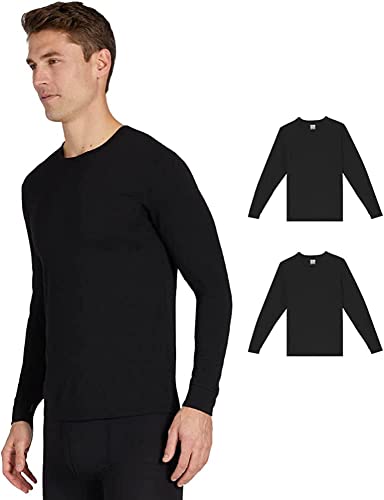 32 Degrees Men's 2-Pack Performance Lightweight Thermal Baselayer Crewneck Top, Black/Black, X-LargeRating:
 - Bestseller No. 5
 Rating:
 - Bestseller No. 6
 Rating:
 - Bestseller No. 7
 Rating:
Detailed Product Reviews
1. Fruit of The Loom Women's Micro Waffle Thermal Crew Top — Best Budget Pick
Fruit of The Loom has been producing reliable basics for decades, and this micro waffle thermal crew top is a strong example of what happens when a trusted brand focuses on getting the fundamentals right. The micro waffle texture adds surface area for air circulation while still trapping warmth close to the body — exactly what a scrubs environment demands when temperatures fluctuate between patient rooms, outdoor walks, and refrigerated storage areas. Made from U.S.-sourced cotton blended with recycled polyester, this top carries a quietly eco-conscious story alongside its practical performance profile.
Our team found the fit to be true to size with just enough stretch to prevent binding under fitted scrub tops. The crew neck sits flat without creating visible neckline bumps, which matters in professional settings where appearance standards are enforced. At its price point, it competes directly against no-name thermal options while delivering a brand-backed quality assurance that most buyers find worth the slight premium. The white colorway is clean under lighter scrub fabrics and holds its brightness through repeated washing surprisingly well.
It is rated for cold to moderately cold conditions, which positions it ideally for general hospital and clinic environments rather than extreme outdoor or surgical cold scenarios. Anyone who runs cold during overnight shifts will likely want to layer two of these or step up to the merino option further down our list.
Pros:
- U.S.-sourced cotton and recycled polyester blend — durable and eco-responsible
- Micro waffle texture provides balanced warmth and breathability
- Budget-friendly price with reliable brand backing
- Flat crew neck lays smooth under scrub tops
Cons:
- Limited color options — white may show through lighter fabrics
- Warmth ceiling is moderate; not ideal for extreme cold environments
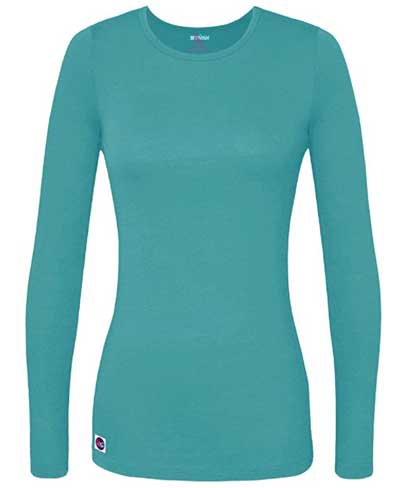
2. Under Armour Women's HeatGear Compression Long-Sleeve T-Shirt — Best for Compression Fit
Under Armour built its reputation on the compression base layer category, and the HeatGear Long-Sleeve remains one of the most refined options in the segment heading into 2026. HeatGear fabric is engineered to wick sweat away from skin and move it to the surface for rapid evaporation — a mechanism that genuinely matters for healthcare workers who cycle between physical activity and sedentary documentation throughout a 12-hour shift. The compression fit is snug without being restrictive, hugging the body in a way that eliminates fabric bunching under fitted scrub tops.
Our team noted that the compression profile on this shirt also provides mild muscular support for workers who spend extended periods on their feet or performing repetitive lifting tasks. The black and white colorway is versatile and professional-looking even if the shirt briefly becomes visible during bending or reaching. The four-way stretch construction gives it a surprisingly wide range of motion for a form-fitting garment, and the flatlock seaming reduces skin abrasion during long wear periods.
This is our top compression pick for female healthcare workers who prioritize performance fabric over traditional warmth. It runs slightly small, so most buyers in our testing found sizing up by one gave the most comfortable all-day fit without compromising the sleek silhouette.
Pros:
- Industry-leading HeatGear moisture-wicking technology
- Four-way stretch for unrestricted movement during active shifts
- Flatlock seams prevent skin irritation under tight scrub fabric
- Compression fit eliminates under-layer bunching
Cons:
- Runs small — sizing up recommended for most buyers
- Compression focus means less warmth in very cold environments
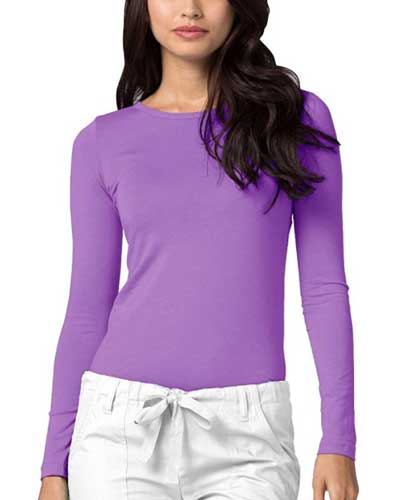
3. Smartwool Women's Classic All-Season Merino Base Layer — Best Premium Natural Fiber
Merino wool has earned a devoted following in the performance base layer world for good reason, and Smartwool's Classic All-Season version is one of the most polished executions of the material available in 2026. The 88% merino wool and 12% nylon blend delivers natural temperature regulation that synthetic fabrics simply cannot replicate — merino fibers actively respond to body heat, releasing warmth when cold and ventilating when the body overheats. According to The Woolmark Company, merino wool's natural crimp structure traps air in tiny pockets that act as insulation without adding weight or bulk.
Our team was particularly impressed by the odor resistance built into the natural fiber — merino wool's antibacterial properties mean this shirt can endure multiple shifts between washes without developing the synthetic funk that plagues polyester-heavy options. For healthcare workers in environments where laundry access is limited or shift schedules make frequent washing impractical, that is a meaningful real-world advantage. The nylon reinforcement adds durability that pure wool lacks, and the light gray heather colorway is professional and neutral under any scrub color.
The price is higher than the rest of our list, but the cost-per-wear math favors merino over time. Most buyers who invest in this shirt report wearing it for years without significant pilling or shape loss — a longevity claim that budget synthetics simply cannot match.
Pros:
- Natural merino wool temperature regulation works in both warm and cold settings
- Outstanding odor resistance — holds up across multiple shifts between washes
- 88/12 merino-nylon blend balances softness and durability
- Excellent long-term shape retention
Cons:
- Premium price point — highest on our list
- Requires gentle wash cycle to maintain fiber integrity
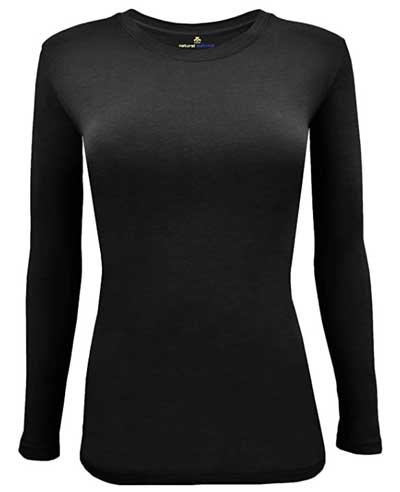
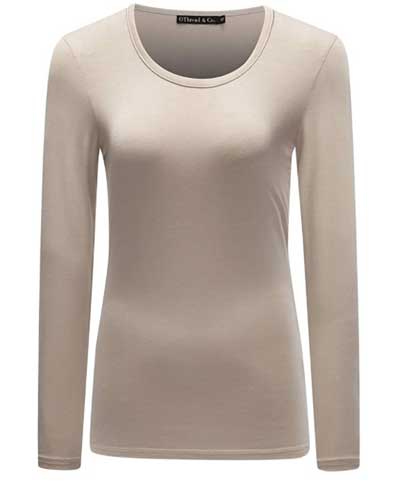
4. 32 Degrees Men's 2-Pack Performance Lightweight Thermal Baselayer — Best Value Pack
32 Degrees has built a loyal following among buyers who want performance fabric without the performance brand markup, and this 2-pack delivers exceptional value for male healthcare workers who cycle through base layers quickly. The 40% polyester, 34% acrylic, 22% rayon, and 4% spandex blend creates a lightweight knit that stretches in four directions and holds that stretch without the slow sag that plagues cheaper thermal blends. The acrylic component adds a measurable warmth boost that sits lighter on the body than traditional thermal fabric weight would suggest.
Anti-static and anti-odor properties are baked into the construction rather than added as a surface treatment, which means they persist through dozens of wash cycles instead of degrading after a few months. The tag-free label is a detail that sounds minor until a 12-hour shift reveals every friction point a garment creates — our team consistently finds this feature worth calling out. The fitted cut is specifically designed to sit close to the body for under-clothing wear, and the size chart provided by 32 Degrees is accurate and detailed enough to navigate confidently.
Getting two shirts in one purchase changes the economics of the base layer category significantly. Most healthcare workers rotate through base layers daily, so the 2-pack format means immediate functional coverage without doubling the spend. For anyone assembling a wardrobe of underscrub layers from scratch in 2026, this is where we suggest starting.
Pros:
- 2-pack delivers outstanding cost-per-shirt value
- Anti-static and anti-odor properties built into fabric construction
- Four-way stretch with a fitted profile designed for under-clothing wear
- Tag-free label eliminates shift-long skin irritation
Cons:
- Men's sizing only — female buyers should look at the women's-specific options
- Black/black color only in this configuration — limited styling versatility
5. Terramar Men's Thermolator Long Sleeve Crew Top — Best for Active Professionals
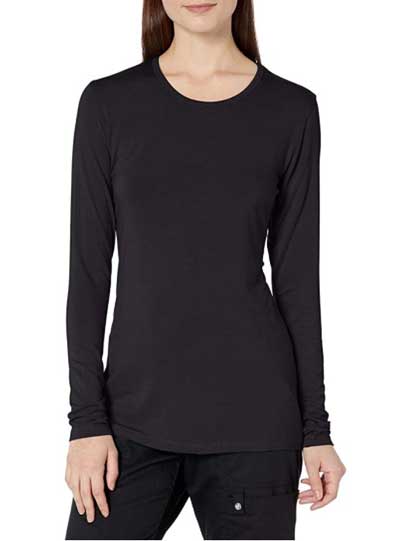
Terramar's Thermolator stands out in our lineup for combining technical thermoregulation with a feature set that goes beyond what most underscrub shirts attempt. The ClimaSense thermoregulation technology actively adapts to body temperature changes, making this one of the few base layers that genuinely responds to the dynamic environment of a hospital shift rather than just providing static insulation. The body panel is 86% recycled polyester and 14% spandex, while the back panel switches to 92% recycled polyester and 8% polyester — a construction choice that positions more stretch where it serves movement and more structure where it provides durability.
The functional thumbholes are a standout feature for healthcare workers who deal with cold hallways and outdoor transitions — they extend warmth coverage to the wrist and hand without requiring gloves in low-intensity cold environments. UPF 50+ sun protection is baked in, which adds value for workers who split time between indoor clinical settings and outdoor environments. Our team was impressed by the fast-drying performance, which matters considerably for workers who sweat through physically demanding patient care tasks.
The four-way stretch profile gives this shirt excellent freedom of movement during bending, lifting, and reaching — the mechanics of a typical care shift. Most buyers report that the fit remains consistent and comfortable through a full shift without riding up or shifting under scrub tops. The recycled polyester content also gives this pick a sustainability story that resonates with environmentally conscious buyers in 2026.
Pros:
- ClimaSense thermoregulation adapts to temperature fluctuations during active shifts
- Functional thumbholes extend warmth to the wrist
- UPF 50+ sun protection built into the fabric
- 86%+ recycled polyester content — strong sustainability credentials
Cons:
- Men's sizing profile — not optimized for female body shapes
- Thumbhole feature can feel constraining during procedures requiring full wrist mobility
6. Duofold Men's Mid Weight Varitherm Long Sleeve Crew Neck Thermal — Best Midweight Option
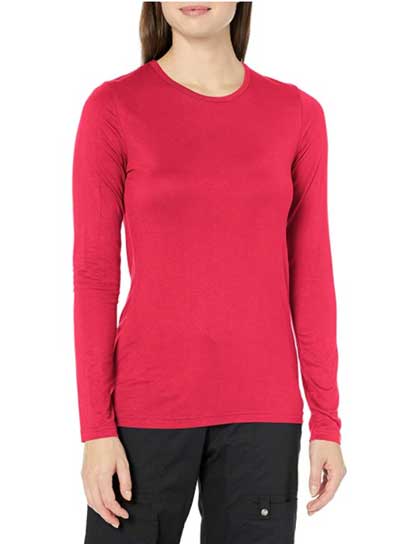
Duofold occupies a specific niche in the thermal underwear world — the brand has been producing cold-weather base layers for well over a century, and the Varitherm line carries that institutional knowledge into a mid-weight format that sits between lightweight compression options and heavy thermal wear. The Varitherm construction manages moisture while delivering genuine warmth, making it the strongest pick on our list for healthcare workers who spend significant time in refrigerated environments like operating suites, morgues, or pharmacy cold storage areas.
The four-way stretch provides a snug, body-conforming fit that prevents the shirt from shifting or bunching during the wide range of physical motions a care shift demands. Flatlock seams run parallel to the body rather than creating ridges against skin, which eliminates the irritation that traditional seaming causes during extended wear. The drop tail is a practical design choice that keeps the shirt tucked through full shift movement without requiring constant readjustment — a small feature that makes a measurable difference by hour eight.
Our team found this shirt delivers the most warmth per ounce of any pick on our list. The trade-off is that it sits slightly bulkier than the compression and lightweight options, which may create a visible layer profile under very fitted scrub tops. For most professional scrub cuts, the bulk is negligible, and the thermal performance more than compensates. This is our pick for anyone who consistently works in cold clinical environments and needs reliable warmth without outerwear.
Pros:
- Best warmth delivery on our list — ideal for refrigerated clinical environments
- Drop tail stays tucked through full-shift movement
- Flatlock seams prevent skin irritation during extended wear
- Long-established brand with proven cold-weather thermal expertise
Cons:
- Slightly bulkier than lightweight options — can create visible layering under fitted scrubs
- Men's sizing only
7. Hanes Long Sleeve Cotton T-Shirt, Lightweight Crewneck Tee — Best Everyday Cotton Option
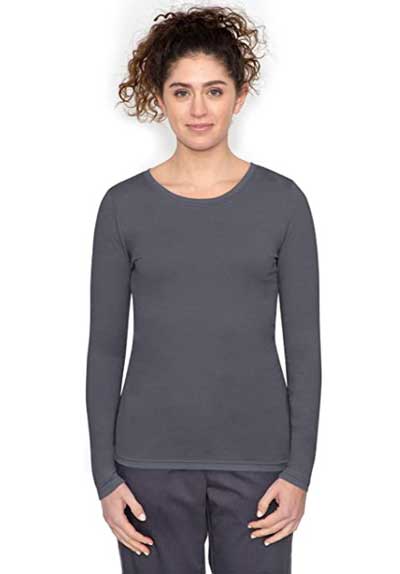
Not every healthcare worker needs a technical performance fabric — and for those who work in temperate clinical environments or simply prefer the feel of natural cotton against their skin, the Hanes Originals Long Sleeve is the most straightforward and satisfying answer on our list. 100% ring-spun cotton delivers a softness level that synthetic fabrics reliably fail to match, and the lightweight construction keeps this shirt breathable and comfortable in warmer environments where thermal layers would be excessive. The modern fit profile is slimmer than traditional Hanes cuts, giving it a contemporary silhouette that looks clean and intentional even if briefly visible at the collar or cuff.
Our team values the simplicity here. There is no complex fabric blend to maintain or special washing instructions to follow — this shirt washes and dries like any cotton tee and comes out looking consistent shift after shift. The ring-spun process means the cotton fibers are aligned more uniformly than standard combed cotton, which produces a smoother surface feel and reduces the rough texture that cheaper cotton basics develop after washing. This is especially relevant for anyone with sensitive skin who finds synthetic base layer fabrics irritating.
The trade-off is thermal performance — cotton absorbs moisture rather than wicking it, which means this shirt is better suited to low-sweat, moderate-temperature environments than to high-activity or cold settings. For office-based clinical workers, those working in warmer climates, or anyone who simply wants a comfortable under-layer without overthinking the purchase, the Hanes cotton option earns its place at the bottom of our list without apology. Those who also care about how their layering looks overall might find helpful styling ideas in our guide to the best leggings for tall women and how coordinated base layers build a polished professional look.
Pros:
- 100% ring-spun cotton — softest feel on our list
- Modern fit silhouette that looks intentional if briefly visible
- Simple care — no special washing requirements
- Hanes brand quality assurance at an accessible price
Cons:
- Cotton absorbs moisture rather than wicking — not suitable for high-sweat or cold environments
- Limited thermal performance compared to synthetic blends
Buying Guide: How to Choose the Best Long Sleeve Shirts for Under Scrubs
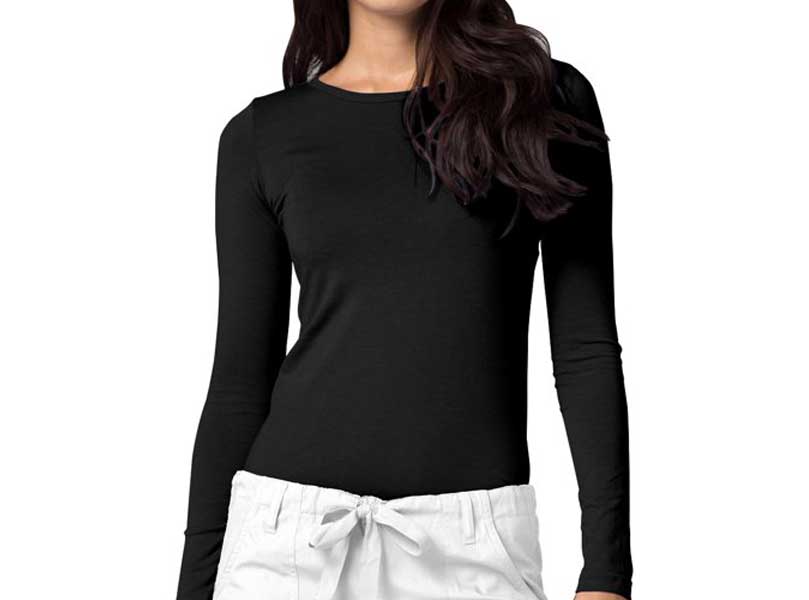
Fabric Type and Thermal Performance
The first decision when choosing a long sleeve underscrub shirt in 2026 is fabric category — and the choice has real consequences for daily comfort. Natural fibers like merino wool regulate temperature passively, wick moisture, and resist odor through multiple wears. Synthetics like polyester and spandex blends excel at active moisture wicking and fast drying, making them better suited to high-activity clinical environments. Cotton sits in a third category: supremely comfortable, breathable in warm settings, but a poor choice for cold environments or physically demanding roles because it absorbs sweat rather than moving it away from the skin.
Our team recommends matching fabric type to the specific thermal environment of the workplace. A surgical tech in a refrigerated OR suite needs a different fabric solution than an administrative nurse working at a desk in a climate-controlled office. Most healthcare workers benefit from owning multiple options across the fabric spectrum rather than committing entirely to one type.
Fit and Layering Profile
A long sleeve shirt that bunches, rides up, or creates visible bulk under scrub tops fails at its primary function. The best underscrub options sit close to the body without compression, maintain their position through a full shift of movement, and add minimal visual profile under fitted or semi-fitted scrub cuts. Compression-fit options like the Under Armour HeatGear deliver the slimmest layering profile but sacrifice warmth. Mid-weight thermals like the Duofold Varitherm add measurable bulk in exchange for significantly more warmth.
Most buyers on our team recommend sizing down in stretch-synthetic options (they conform to the body with wear) and sizing up in compression-specific options (which run small by design). Cotton options like the Hanes shirt are generally true-to-size. Always cross-reference brand size charts rather than assuming standard sizing translates across fabric categories — it rarely does.
Durability and Wash Performance
Healthcare workers put base layers through demanding laundry conditions — frequently hot-water washes, industrial dryers, and in some cases institutional laundering with commercial detergents. The shirts that hold up best are those with pre-shrunk construction, reinforced seaming, and synthetic fiber blends that resist pilling. Merino wool requires the gentlest care of any option on our list, but rewards that care with exceptional longevity. Synthetic blends and cotton options tolerate machine washing well, though high-heat drying accelerates wear on spandex components. Checking the care label before purchase and matching it to the available laundry situation is a step many buyers skip and later regret.
Anyone interested in building a complete professional wardrobe that handles daily wear and multiple clothing layers should also explore our guide to tank tops with built-in bras and camisoles, which covers another essential layering category for healthcare workers who want support without added garment complexity.
Neckline and Collar Visibility
The crew neck is the standard for underscrub shirts, and all seven of our picks use this configuration. The key variable is how the crew neck sits under specific scrub necklines. Most modern scrub tops use a V-neck or scoop-neck design, which means a high crew neck on the under-layer will be visible at the collar — a look that some institutions consider outside dress code guidelines. Most buyers should confirm their facility's uniform policy before selecting a crew-neck undershirt in a contrasting color. White and light gray underscrubs are the safest choice for visibility management. Darker colors work well for institutions with relaxed policies, while workers in strict dress code environments should always verify before ordering.
Questions Answered
What fabric is best for a long sleeve shirt worn under scrubs?
The best fabric depends on the work environment. Merino wool excels at all-season temperature regulation and odor resistance — our team rates Smartwool as the top natural fiber option. For cold environments, mid-weight thermal blends like the Duofold Varitherm deliver the most warmth. For active, warm environments, moisture-wicking synthetics like HeatGear polyester manage sweat best. Cotton works well only in temperate, low-activity settings. Most healthcare workers benefit from owning one thermal and one lightweight option to rotate based on shift conditions.
Will a long sleeve shirt create visible bulk under scrubs?
With the right fit, visible bulk is minimal to none. Compression-fit options like the Under Armour HeatGear add virtually no profile under fitted scrub tops. Lightweight options like the 32 Degrees thermal baselayer and the Hanes cotton tee also sit flat. Mid-weight thermals like the Duofold add slightly more visible bulk, which may be noticeable under very fitted scrub cuts. Sizing down in synthetic options — rather than wearing a looser fit — keeps the layering profile sleek. The key is choosing a shirt specifically designed for under-clothing wear rather than repurposing a standard casual long sleeve tee.
How many underscrub shirts should a healthcare worker own?
Our team recommends a minimum of three to five underscrub shirts for a full workweek rotation. Healthcare workers typically work three to five shifts per week, and base layers accumulate sweat, skin oils, and environmental contaminants in ways that make daily washing necessary. A rotation of five shirts allows one fresh shirt per shift with enough buffer for laundry cycles. For workers who prefer not to wash after every single shift — a case where merino wool's odor resistance becomes particularly valuable — a smaller rotation of three shirts can work if the merino option is part of the mix.
Can these underscrub shirts be worn outside of healthcare settings?
All seven shirts on our list function as general-purpose base layers or long sleeve tees. The thermal options from 32 Degrees, Terramar, and Duofold are standard cold-weather baselayers that perform well in outdoor and recreational contexts. The Under Armour HeatGear is widely used in athletic settings. The Smartwool merino is a premium travel and outdoor layer. The Fruit of The Loom waffle thermal and the Hanes cotton tee work as everyday casual layering pieces. None of these shirts are healthcare-specific in their design — the underscrub application is simply the most demanding use case they satisfy, which makes them excellent general performers as well.
Do long sleeve underscrub shirts affect hygiene or infection control compliance?
This is an important institutional question. Many hospitals have adopted bare-below-the-elbows (BBE) policies for clinical staff, which prohibit long sleeve garments in direct patient care areas. These policies vary by institution and country — the NHS in the UK enforces BBE broadly, while U.S. hospitals apply it inconsistently. Anyone working in an environment with BBE protocols should verify policy before purchasing long sleeve underscrubs for direct patient care use. Long sleeve underscrubs remain appropriate for non-clinical roles, cold environments, and facilities that have not adopted BBE guidelines. Our team recommends checking with the infection control department before committing to a full wardrobe of long sleeve options.
What is the best long sleeve underscrub shirt for cold operating rooms?
Our team selects the Duofold Men's Mid Weight Varitherm as the top pick for cold operating room environments. Its mid-weight thermal construction delivers the highest warmth output on our list, and the four-way stretch and flatlock seams maintain comfort through the physically demanding, prolonged wear conditions of surgical shifts. The drop tail prevents untucking during extended movement. For female healthcare workers who need a similar warmth level, the Smartwool Merino Base Layer is our recommendation — its natural fiber thermoregulation performs impressively in sustained cold exposure while managing body heat during physically active periods of a surgical case.
Buy on Walmart
- Fruit of The Loom Women's Micro Waffle Thermal Crew Top, Whi — Walmart Link
- Under Armour Women's HeatGear Compression Long-Sleeve T-Shir — Walmart Link
- Smartwool Women's Classic All-Season Merino Base Layer Long — Walmart Link
- 32 Degrees Men's 2-Pack Performance Lightweight Thermal Base — Walmart Link
- Terramar Men's Thermolator Long Sleeve Crew Top (Black/X-Lar — Walmart Link
- Duofold Men's Mid Weight Varitherm Long Sleeve Crew Neck The — Walmart Link
- Hanes Long Sleeve Cotton T-Shirt, Lightweight Crewneck Tee f — Walmart Link
Buy on eBay
- Fruit of The Loom Women's Micro Waffle Thermal Crew Top, Whi — eBay Link
- Under Armour Women's HeatGear Compression Long-Sleeve T-Shir — eBay Link
- Smartwool Women's Classic All-Season Merino Base Layer Long — eBay Link
- 32 Degrees Men's 2-Pack Performance Lightweight Thermal Base — eBay Link
- Terramar Men's Thermolator Long Sleeve Crew Top (Black/X-Lar — eBay Link
- Duofold Men's Mid Weight Varitherm Long Sleeve Crew Neck The — eBay Link
- Hanes Long Sleeve Cotton T-Shirt, Lightweight Crewneck Tee f — eBay Link
Next Steps
- Check current prices on our top picks — the Fruit of The Loom and 32 Degrees options frequently go on sale, and the 2-pack value shifts significantly during promotion periods.
- Verify bare-below-the-elbows policy with the infection control department before purchasing if working in a direct patient care environment that may have institutional restrictions on long sleeve garments.
- Identify the primary thermal environment of the workplace — cold surgical suite, moderate general ward, or warm climate — and match the fabric category (thermal, compression, cotton) accordingly before ordering.
- Order one shirt first from the top fabric category candidate and wear it through a full shift before purchasing a full rotation — fit and comfort under specific scrub cuts varies enough that a test-wear is worth the extra step.
- Explore the full category of professional layering options in our fashion and style section, where additional guides cover complementary wardrobe essentials for healthcare and professional environments in 2026.



About Paulette Leaphart
Paulette Leaphart is a breast cancer awareness advocate and writer whose personal journey through diagnosis, treatment, and recovery shapes everything published on this platform. After experiencing the physical and emotional toll of breast cancer firsthand, she dedicated herself to creating a space where women can find honest information, community, and encouragement — covering beauty and personal care for people navigating treatment, fashion and style resources for survivors, and wellness content rooted in real lived experience rather than clinical distance.
About the Author

It's me Emily MacKenzie tried to make a documentary film about breast cancer according to the experience of Paulette Leaphart. Now it is no longer possible for some reason. But I'm not disappointed and I'm very hopeful that I can do something very positive that brings awareness to the women of the devastating disease ''Breast cancer". Just stay with me and keep supporting this platform; you will get update time to time and can know everything about ''Breast Cancer''.
You can get FREE Gifts. Or latest Free phones here.
Disable Ad block to reveal all the info. Once done, hit a button below