Which flushable wipe actually delivers on its promise of freshness, flushability, and skin comfort — and which ones are just overpriced toilet paper alternatives that can clog your pipes? If you've found yourself staring at a wall of options at the store, you're not alone. In 2026, the flushable wipe market has grown considerably, with dozens of brands claiming superior softness, sewer safety, and skin-friendly formulas. The good news: one product stands out early for everyday use, and that's the Cottonelle Fresh Care Flushable Wet Wipes — a reliable, widely available option that has maintained its reputation for breaking down safely in plumbing systems. But your ideal pick depends on your priorities, and that's exactly what this guide is designed to help you sort out.
Flushable wipes have become a staple in many households for good reason. According to hygiene researchers, moist wipes remove residue and odor more effectively than dry toilet paper alone, making them a popular choice for adults who want a cleaner, more refreshed feeling after each bathroom visit. They're also increasingly popular among people managing sensitive skin conditions, post-surgical recovery, or mobility challenges — a reality explored further in our coverage of best wiping aids for obese people, where comfort and reach matter as much as product quality. Whether you're shopping for everyday use, travel convenience, or a more eco-conscious option, the wipes on this list cover the full range of what's available in 2026.
What separates a genuinely flushable wipe from one that merely claims to be? The answer lies in the fiber composition, breakdown speed, and third-party certification standards — factors that most shoppers overlook when reaching for the familiar brand. This review covers seven top-rated flushable wipes currently available on Amazon, evaluating each for its cleaning performance, skin compatibility, environmental footprint, and true plumbing safety. You'll also find a detailed beauty and personal care buying guide at the end to help you weigh the factors that matter most to your specific situation. For additional bathroom comfort product comparisons, our roundup of best toilet paper sprays offers a complementary perspective on cleanliness solutions that pair well with wipes.

Contents
Best Choices for 2026
- #PreviewProductRating
- Bestseller No. 1
 Rating:

- Bestseller No. 2
 Rating:
 - Bestseller No. 3
 Rating:
 - Bestseller No. 4
 Rating:
 - Bestseller No. 5
 Rating:
 - Bestseller No. 6
 Rating:
 - Bestseller No. 7
 Rating:

Product Reviews
1. Cottonelle Fresh Care Flushable Wet Wipes — Best Overall for Daily Use
Cottonelle's Fresh Care Flushable Wet Wipes have long been positioned as the benchmark for mainstream flushable wipes, and in 2026, that reputation holds up under scrutiny. Each pack contains 42 wipes in a convenient flip-top dispenser, with the four-pack bundle delivering 168 total wipes — enough supply for a household to rely on these as a daily bathroom staple rather than an occasional treat. The brand's central claim is that these wipes remove up to 100% of odor and residue, and based on consumer feedback and the texture of the cloth itself, there's meaningful support for that assertion. The wipes are pre-moistened with a gentle cleansing solution that feels neither too wet nor too dry, striking a balance that most users find comfortable on repeated daily use.
The flushability claim is where Cottonelle distinguishes itself from many competitors. The company states these wipes begin breaking up as fast as Cottonelle Ultra Clean toilet paper and achieve the same degree of breakdown after 30 minutes — a standard that is meant to reassure users with septic systems and older plumbing. The asterisk on that claim is worth noting: the comparison is to their own toilet paper product, not an independent industry standard. That said, Cottonelle has maintained a strong safety track record in independently tested reviews, and the wipes do show measurable disintegration in standard slosh-box tests used by industry bodies. For most residential plumbing scenarios, these wipes perform as advertised when users limit the number flushed per use.
Where this product excels is consistency. The flip-top pack design keeps wipes moist through the last sheet, and the packaging is compact enough to fit discreetly on a bathroom shelf or in a cabinet. The mild, fresh scent is present but not overpowering, which makes these suitable for most users who aren't fragrance-sensitive. If you're looking for one product to cover the basics well without overthinking the decision, the Cottonelle Fresh Care Flushable Wet Wipes represent the kind of dependable, accessible option that earns its place as the default choice for most households in 2026.
Pros:
- Breaks down comparably to toilet paper, making it safer for most plumbing systems
- Flip-top packaging maintains moisture through all 42 wipes in each pack
- Removes up to 100% of odor and residue for a thorough clean
- Four-pack bundle offers strong value for everyday household use
Cons:
- Flushability comparison references Cottonelle's own product, not a universal standard
- Light fragrance may be a drawback for those with fragrance sensitivities

2. Charmin Flushable Wipes — Best Bulk Value for Families
When value by volume is your primary concern, the Charmin Flushable Wipes deliver in a way that few competitors can match at a comparable price point. This bundle includes 12 packs of 40 sheets each, totaling 480 wipes — enough to supply a family of four for several weeks without a restock run. Charmin is a household name in the toilet paper category, and the brand carries that familiarity and trust into its wipes product. Each individual pack features a re-sealable top, which is a practical design choice that keeps the remaining wipes from drying out between uses and makes the packs portable for travel or use in shared bathrooms.
The cleaning performance of Charmin Flushable Wipes is consistent with what you'd expect from a mainstream product in this category — soft, adequately moist, and effective at providing a cleaner feel than dry tissue alone. The texture is slightly thicker than some competitors, which some users prefer for the added tactile confidence it provides during use. Charmin recommends flushing only one or two wipes at a time for best results, a directive that echoes guidance from plumbing professionals who caution against overloading systems even with certified-flushable products. Following this instruction is important if you're on a septic system or have older pipes.
One consideration worth noting for high-volume buyers is that the 12-pack format does require more storage space than smaller bundles. The individual packs are not stackable in the same way as flip-top containers, so bathroom cabinet organization becomes a practical factor for some households. That said, for a family seeking a cost-efficient, dependable wipe that the brand-loyal consumer already trusts in the toilet paper aisle, Charmin's entry into the flushable wipes category makes logical sense. This is the product most likely to satisfy a household that wants bulk convenience without experimenting with unfamiliar brands.
Pros:
- 480 total wipes across 12 packs makes this one of the best per-wipe value options available
- Re-sealable individual pack design prevents moisture loss between uses
- Familiar brand name inspires confidence for first-time flushable wipe buyers
Cons:
- Requires flushing only one to two wipes at a time for safe plumbing performance
- Bulkier multi-pack format requires more storage space than compact alternatives
3. Cottonelle GentlePlus Flushable Wet Wipes with Aloe & Vitamin E — Best for Sensitive Skin
For users whose primary concern is skin comfort rather than simply cleaning performance, Cottonelle's GentlePlus line introduces a meaningful upgrade over the standard Fresh Care formula. The key differentiator is the inclusion of aloe, vitamin E, and chamomile — three ingredients with well-established soothing and moisturizing properties that make a noticeable difference for people with reactive or sensitive skin. The eight-pack bundle totals 336 wipes, making this a substantial purchase that positions the GentlePlus as a long-term daily solution rather than a trial run. Each flip-top pack holds the same 42-wipe count as the Fresh Care line, and the packaging quality is identical in its ability to maintain moisture through the last wipe in each pack.
The skin-feel of the GentlePlus wipe is noticeably softer and more cushioned than the standard Fresh Care option, even though both products share the same fiber base and breakdown technology. The chamomile inclusion in particular contributes a mild calming effect that users managing conditions like eczema, postpartum sensitivity, or hemorrhoid-related irritation will find relevant. Unlike some "sensitive" personal care products that strip out all active ingredients to achieve a neutral profile, Cottonelle's approach here is to add soothing botanicals rather than merely eliminating irritants — an approach that typically produces a more positive experience for the target demographic.
The flushability standards are identical to the Fresh Care line, meaning these wipes carry the same septic- and sewer-safe designation with the same breakdown timeline. For users managing both skin sensitivity and plumbing concerns simultaneously — a combination that's more common than it might seem, particularly among older adults or those with health conditions affecting their bathroom routine — the GentlePlus represents a well-rounded solution. This is also an excellent choice for individuals exploring broader hygiene support tools, including those described in our guide on how obese people manage personal hygiene, where gentle and effective wiping products are particularly relevant.
Pros:
- Aloe, vitamin E, and chamomile formula actively soothes and moisturizes sensitive skin
- Same flushability and sewer-safe standards as the Fresh Care line
- Eight-pack bundle provides 336 wipes for extended use without frequent reordering
- Flip-top design keeps the last wipe as moist as the first
Cons:
- Higher price per wipe compared to the standard Fresh Care option
- Not fragrance-free, which may still be a concern for the most reactive skin types
4. DUDE Wipes On-The-Go Mint Chill Travel Wipes — Best for Travel and On-the-Go Use
DUDE Wipes has carved out a distinctive market position in the flushable wipes category by targeting an audience that finds conventional wipe branding either too clinical or too feminine, and the Mint Chill On-The-Go Travel Wipes represent the brand's travel-focused entry in 2026. Each of the 30 wipes in this package is individually wrapped, which is the critical differentiator that makes this product genuinely practical for use outside the home. An individually wrapped wipe fits in a pocket, gym bag, briefcase, or glove compartment without the risk of the entire supply drying out — a real-world convenience advantage that the standard flip-top format cannot offer in a portable context.
The wipe itself is notably large — DUDE markets these as extra-large, and the dimensions back that claim up compared to standard-sized wipes from competing brands. The Mint Chill formula adds tea tree oil, vitamin E, and aloe to the cleansing solution, delivering a cooling sensation that users in warmer climates or active lifestyles tend to appreciate. Tea tree oil brings mild antimicrobial properties to the formulation, which adds a layer of confidence for use in public restrooms or after physical activity. The mint sensation is present and immediate but fades quickly, making the overall experience refreshing rather than medicinal.
The 30-count format is not designed for household bulk use — this is explicitly a travel and on-the-go product, and its pricing reflects that positioning. For users who already have a primary flip-top product at home and need a travel companion that fits in a jacket pocket without compromise, the DUDE Wipes Mint Chill is the most practical solution on this list. The brand confirms these are septic- and sewer-safe, and the individually wrapped format means you only open and expose one wipe at a time, which maintains freshness through the entire 30-count supply regardless of how slowly you work through the package.
Pros:
- Individually wrapped format is genuinely portable for gym bags, pockets, and travel
- Extra-large wipe size provides more thorough coverage than standard alternatives
- Tea tree oil, vitamin E, and aloe add antimicrobial and soothing benefits
- Cooling mint sensation is distinctive and refreshing without being harsh
Cons:
- 30-count supply is not suitable as a primary household product — requires frequent reordering
- Higher per-unit cost compared to bulk flip-top alternatives
5. Kirkland Signature Moist Flushable Wipes — Best Costco Value
Kirkland Signature's entry into the flushable wipes market follows the same formula that has made the Costco house brand successful across dozens of product categories: competitive quality at a price per unit that mainstream brands struggle to match. This three-pack delivers 180 wipes total — 60 per container — using plant-based materials that are free from chemical binders, a construction approach that supports both skin safety and environmental considerations. The 100% plant-based fiber composition means these wipes disintegrate in water more readily than synthetic-fiber alternatives, which is a genuine advantage for septic users and environmentally conscious households who want to minimize their plumbing impact.
The formula includes aloe and vitamin E alongside a hypoallergenic, alcohol-free base, which positions Kirkland Signature alongside premium sensitive-skin products rather than bargain-bin alternatives. Consumer testing cited in the product documentation scored these wipes high for both softness and strength — two attributes that tend to trade off against each other in lower-quality wipes where manufacturers sacrifice one to achieve the other. The texture is thick enough to feel substantial in use, yet soft enough not to cause irritation during repeated daily application. For a store-brand product, the quality gap compared to name-brand competitors is narrower than many shoppers might expect.
The primary practical limitation of Kirkland Signature wipes is that they are most economically available through Costco membership and the Amazon marketplace, where the per-unit cost advantage is partially offset by shipping fees for non-Prime bulk orders. For households that already shop at Costco regularly, picking these up in-store remains the most cost-efficient approach. On Amazon, the three-pack represents reasonable value, though comparing price-per-wipe across the products on this list before purchasing is worthwhile given the variability in bundle sizes. In terms of raw material quality and ingredient safety for everyday use, Kirkland Signature punches above its price point with consistency.
Pros:
- 100% plant-based, chemical-binder-free construction supports safe flushability and skin health
- Hypoallergenic and alcohol-free formula with aloe and vitamin E suits sensitive skin
- Strong per-wipe value, particularly when purchased through Costco directly
Cons:
- Most economical when purchased in-store at Costco; Amazon pricing narrows the value gap
- 60-per-container wipe count is lower than comparable bundles from other brands
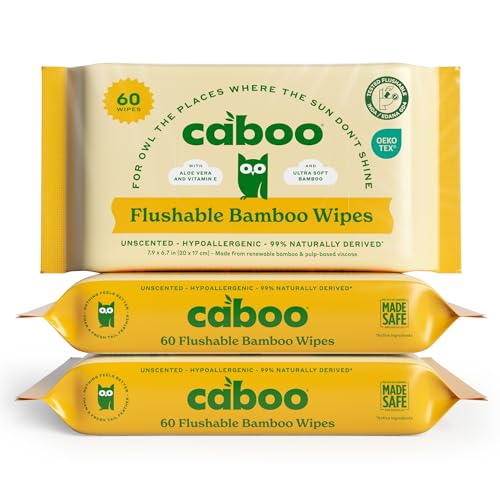
6. Caboo Tree Free Flushable Wipes — Best Eco-Conscious Choice
Caboo's Tree Free Flushable Wipes represent the most environmentally differentiated product on this list, built around a bamboo-based viscose fiber that the brand argues is a more sustainable raw material than conventional wood pulp or synthetic alternatives. Bamboo's growth cycle — maturing in three to four months compared to thirty years for most commercially harvested trees — is a legitimately meaningful advantage from a resource regeneration standpoint, and Caboo's MADE SAFE certification adds third-party verification that the ingredients meet safety standards for both personal use and environmental release. The three-pack delivers 180 total wipes across unscented individual packs that are notably free of fragrances, dyes, and harsh chemical additives.
The flushability credentials of Caboo wipes are among the strongest on this list in terms of third-party verification. The product is certified flushable per INDA/EDANA Flushability Assessment Guidelines — the same international standard used by wastewater management professionals to evaluate whether a product is genuinely safe for sewer and septic systems. This is important context, because fatbergs — massive blockages caused by non-flushable materials in sewer systems — have become a documented infrastructure problem in many municipalities, and the distinction between certified-flushable and merely-marketed-as-flushable matters considerably for both personal plumbing and broader public sanitation infrastructure.
The Caboo wipes are also marketed as suitable for motorhome and marine sanitation systems, which are significantly more sensitive to wipe fiber composition than residential plumbing. This makes Caboo a compelling choice for RV owners, boat users, and campers who need a flushable wipe that genuinely won't compromise their sanitation systems in confined, hard-to-service settings. The unscented formula simultaneously makes this the strongest option for fragrance-sensitive users who have eliminated other wipes from consideration due to their scent profile. For the environmentally aware household or the outdoor adventurer, Caboo offers a genuine combination of eco-credentials and verified performance that sets it apart from the mainstream field.
Pros:
- INDA/EDANA certified flushable — strongest third-party verification on this list
- Bamboo-based viscose offers a meaningfully more sustainable raw material than tree pulp
- Unscented and fragrance-free, suitable for even the most sensitive skin types
- Safe for motorhome and marine sanitation systems — versatile beyond residential use
Cons:
- Higher price per wipe compared to mainstream alternatives like Cottonelle and Charmin
- Bamboo viscose, while more sustainable than trees, is still a processed fiber — not fully biodegradable in the same way as natural cotton
7. The Honest Company Hypoallergenic Flushable Wipes — Best for Dermatologist-Tested Safety
The Honest Company built its brand identity around transparency in ingredient sourcing and rigorous testing standards, and its Hypoallergenic Flushable Wipes deliver on that identity in a product that carries more third-party verification than almost any other wipe on this list. The 126-count package is formulated with over 99% water and a soft plant-based cloth, which keeps the ingredient complexity minimal and the skin interaction predictably gentle. EWG verification, dermatologist testing, and gynecologist testing are all on record for this product — a combination of endorsements that speaks directly to users who have medical or clinical reasons for being cautious about what touches their skin repeatedly each day.
The fragrance-free formulation is not a compromise here but a deliberate design decision that makes these wipes appropriate for users with a documented history of fragrance sensitivity, contact dermatitis, or gynecological conditions where scented products can cause irritation or disrupt natural pH balance. The Honest Company recommends flushing one wipe at a time and not exceeding two wipes per flush — guidance consistent with industry best practice for maintaining plumbing safety even with certified-flushable products. The soft plant-based cloth composition supports the brand's sewer- and septic-safe claim, and the wipes are designed to break down comparably to toilet paper when introduced to water.
For parents who want the same product used for baby wipes to carry into adult personal care — or for adults in medically sensitive situations who need the same level of ingredient scrutiny applied to their personal hygiene products — The Honest Company Flushable Wipes represent the most clinically validated option on this list. The 126-count supply is a reasonable volume for individual or small household use, though families or high-frequency users may find themselves reordering more frequently than they would with the larger-volume bundles offered by Cottonelle or Charmin. The trade-off in volume is offset by the depth of safety verification, making this a strong recommendation for anyone for whom ingredient integrity is the non-negotiable priority.
Pros:
- EWG verified, dermatologist tested, and gynecologist tested — strongest clinical credential set on this list
- Over 99% water base with plant-based cloth keeps the formula genuinely simple and skin-safe
- Completely fragrance-free, suitable for the most reactive skin types and gynecological sensitivities
Cons:
- 126-count supply requires more frequent reordering for multi-person households
- One-wipe-at-a-time flushing recommendation requires behavioral adjustment for users accustomed to higher-volume flushing

What to Look For When Buying Flushable Wipes
Genuine Flushability vs. Marketing Claims
The term "flushable" has no universal legal definition in the United States, which means manufacturers can apply it liberally to products that plumbing professionals would consider problematic. When evaluating whether a wipe is genuinely safe to flush, look for third-party certification from bodies such as INDA (Association of the Nonwoven Fabrics Industry) or EDANA, which conduct standardized slosh-box and disintegration tests to verify breakdown performance in water. Certification from these bodies is a meaningful differentiator — it indicates the product has been evaluated against an independent standard rather than simply passing the manufacturer's own internal testing. Among the products reviewed here, Caboo holds the most explicit reference to INDA/EDANA certification, while Cottonelle and The Honest Company reference sewer- and septic-safe standards supported by their own testing protocols. If you are on a septic system, this distinction matters significantly for long-term system health.
Fiber Composition and Skin Safety
The base material of a flushable wipe determines both its breakdown performance and its skin interaction. Plant-based fibers — including bamboo viscose, cellulose, and cotton — generally disintegrate more readily in water than synthetic nonwoven fabrics, and they tend to be gentler on skin during repeated use. If you have known sensitivities to fragrances, alcohol, or preservatives, prioritize products that are explicitly labeled as fragrance-free, alcohol-free, and hypoallergenic. Ingredients like aloe vera, vitamin E, chamomile, and tea tree oil appear across several products on this list and offer legitimate soothing or antimicrobial benefits, but they also introduce additional ingredients that reactive skin types may need to evaluate individually. Reading the full ingredient list before purchasing is advisable for anyone with a documented skin condition or history of contact reactions to personal care products.
Format and Portability
The packaging format of a flushable wipe has practical implications that extend beyond simple aesthetics. Flip-top containers are the standard for home use, offering reliable moisture retention and easy one-handed access — factors that matter for users with mobility limitations, which are worth considering alongside resources like our guide on toileting aids for adults with disabilities or mobility challenges. Individually wrapped wipes sacrifice per-unit value for the genuine portability advantage that makes them practical outside the home. Re-sealable multi-packs fall between these two formats, offering better portability than flip-tops but less moisture protection than individual wrapping. Match the packaging format to your primary use case: home-only users should prioritize flip-top value, while frequent travelers or on-the-go users should pay the premium for individually wrapped options.
Value and Supply Volume
The per-wipe cost of flushable wipes varies significantly across this list, and calculating it correctly requires dividing the total price by the total wipe count rather than comparing package prices directly. Bulk bundles like the Charmin 12-pack and the Cottonelle GentlePlus 8-pack offer lower per-wipe costs but require larger upfront purchases and more storage space. Smaller-count products like The Honest Company 126-count or the DUDE Wipes 30-count carry higher per-unit costs that are justified by specific use-case advantages — clinical ingredient standards and individual wrapping, respectively — rather than by volume efficiency. Determine your household's monthly wipe consumption before purchasing to identify which bundle size represents the best balance of cost, storage, and reorder frequency for your specific situation.
Frequently Asked Questions
Are flushable wipes actually safe to flush?
Certified flushable wipes — those tested against INDA/EDANA or comparable international standards — break down in water at a rate comparable to toilet paper and are generally safe for residential sewer and septic systems when flushed in small quantities (one to two wipes per flush). However, not all products labeled "flushable" have undergone third-party certification, and uncertified wipes may contribute to pipe blockages over time. If you are on a septic system, verify that your chosen product carries an independent flushability certification before making it a daily habit.
What is the difference between flushable and non-flushable wipes?
Flushable wipes are manufactured from fibers — typically plant-based — that are designed to break apart when introduced to water and agitation, mimicking the disintegration behavior of toilet paper. Non-flushable wipes, including most baby wipes, makeup removal wipes, and household cleaning wipes, are made from synthetic nonwoven fabrics that maintain their structure in water and do not break down in plumbing systems. Flushing non-flushable wipes is a leading cause of residential pipe blockages and municipal sewer system fatbergs. Always confirm a wipe's designation before flushing.
Can flushable wipes irritate sensitive skin?
Flushable wipes can irritate sensitive skin if they contain fragrances, alcohol, preservatives, or synthetic dyes that individual users react to. The most common irritants in wipes are fragrance compounds and preservatives like methylisothiazolinone (MI), which have documented rates of contact dermatitis reactions. If you have sensitive skin, look for products that are explicitly fragrance-free, alcohol-free, and hypoallergenic — and ideally those that carry dermatologist testing credentials, such as The Honest Company Hypoallergenic Flushable Wipes reviewed above. Patch testing a new wipe product on a small area of skin before committing to daily use is a prudent step for reactive skin types.
How many flushable wipes should you flush at once?
Most manufacturers recommend flushing no more than one to two wipes per flush, regardless of the product's certified flushability status. This guidance exists because even wipes that break down readily in water take time to disintegrate — introducing too many at once can temporarily overwhelm the water flow capacity of older pipes or slower-draining septic systems. In practice, most users find that one wipe per flush is sufficient for the cleaning task and the safest approach for long-term plumbing health. Users with older homes, narrower pipes, or low-flow toilets should be especially conservative with the number of wipes flushed per use.
Are flushable wipes safe for septic systems?
Flushable wipes that are certified by INDA/EDANA or explicitly labeled as septic-safe have been tested for breakdown performance in closed septic systems and are generally considered safe for use when flushed in small quantities. Plant-based fiber wipes — particularly those made from bamboo viscose or natural cellulose — tend to perform better in septic environments than conventional synthetic-fiber wipes. It is advisable to have your septic system inspected on its regular schedule regardless of the wipes you use, as accumulation over time is possible even with certified-flushable products. Products like Caboo and Kirkland Signature, which emphasize plant-based fiber construction, are particularly well-suited for septic system users.
What are the best flushable wipes for elderly or mobility-limited adults in 2026?
For elderly users or adults with limited mobility, the most important factors in a flushable wipe are packaging accessibility, wipe size, and skin gentleness. Flip-top packs that open with one hand and dispense individual wipes cleanly are easier to manage than re-sealable packs that require two-hand grip. Larger wipe formats — like those offered by DUDE Wipes — reduce the number of applications needed per use, which is a practical advantage for users with reach or dexterity limitations. Gentle formulas with aloe and vitamin E, such as Cottonelle GentlePlus or Kirkland Signature, minimize skin irritation risk for users whose skin may be more fragile due to age or medical conditions. Complementary products designed for mobility-limited individuals are covered in our guide to toileting aids for adults.
Buy on Walmart
- Cottonelle Fresh Care Flushable Wet Wipes, Adult Wet Wipes, — Walmart Link
- Charmin Flushable Wipes, 480 Total Wipes (12 Packs of 40) — Walmart Link
- Cottonelle GentlePlus Flushable Wet Wipes with Aloe & Vitami — Walmart Link
- DUDE Wipes On-The-Go Mint Chill Travel Wipes - 30 Count (Ind — Walmart Link
- Flushable Wipe- Kirkland Signature Moist Flushable Wipes, 18 — Walmart Link
- Caboo Tree Free Flushable Wipes, Certified Flushable, Septic — Walmart Link
- The Honest Company Hypoallergenic Flushable Wipes for Sensit — Walmart Link
Buy on eBay
- Cottonelle Fresh Care Flushable Wet Wipes, Adult Wet Wipes, — eBay Link
- Charmin Flushable Wipes, 480 Total Wipes (12 Packs of 40) — eBay Link
- Cottonelle GentlePlus Flushable Wet Wipes with Aloe & Vitami — eBay Link
- DUDE Wipes On-The-Go Mint Chill Travel Wipes - 30 Count (Ind — eBay Link
- Flushable Wipe- Kirkland Signature Moist Flushable Wipes, 18 — eBay Link
- Caboo Tree Free Flushable Wipes, Certified Flushable, Septic — eBay Link
- The Honest Company Hypoallergenic Flushable Wipes for Sensit — eBay Link
Final Thoughts
Whether you prioritize certified flushability, skin-soothing ingredients, eco-conscious materials, or travel-ready portability, the right flushable wipe for your needs in 2026 is one that aligns with your specific bathroom routine, plumbing situation, and skin health requirements — and this guide has laid out exactly where each product excels so you can make that call with confidence. Review the options, match your priorities to the product that best reflects them, and check current pricing on Amazon to find the best available deal for your preferred choice today.



About Paulette Leaphart
Paulette Leaphart is a breast cancer awareness advocate and writer whose personal journey through diagnosis, treatment, and recovery shapes everything published on this platform. After experiencing the physical and emotional toll of breast cancer firsthand, she dedicated herself to creating a space where women can find honest information, community, and encouragement — covering beauty and personal care for people navigating treatment, fashion and style resources for survivors, and wellness content rooted in real lived experience rather than clinical distance.
About the Author

It's me Emily MacKenzie tried to make a documentary film about breast cancer according to the experience of Paulette Leaphart. Now it is no longer possible for some reason. But I'm not disappointed and I'm very hopeful that I can do something very positive that brings awareness to the women of the devastating disease ''Breast cancer". Just stay with me and keep supporting this platform; you will get update time to time and can know everything about ''Breast Cancer''.
You can get FREE Gifts. Or latest Free phones here.
Disable Ad block to reveal all the info. Once done, hit a button below