The first time you pull on a bra that never quite felt right — the band creeping up your back, the underwire jabbing at your ribs, the straps slipping off your shoulders before lunch — you might assume that's just how bras work. But most of that discomfort isn't about your body. It's about the size. If you've ever been curious about the average bra size in America and where your measurements fall on that spectrum, you're in good company. Getting this right is a small but meaningful part of your wellness and lifestyle routine, and it starts with understanding the numbers.
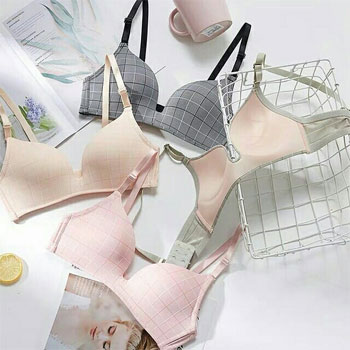
According to fitting data gathered by major lingerie retailers and independent studies, the average bra size in the United States currently sits around a 34DD or 34DDD. That's a notable jump from earlier decades, when a 34B was considered the standard. Several factors drive this shift — changes in average body composition across the population, more precise measuring methods, and a growing cultural awareness that millions of women have been wearing undersized cups for years without realizing it.
Whether you're shopping for the first time in years, reconsidering a size you've worn since your twenties, or simply curious how you compare to the national average, knowing how bra sizing actually works gives you a real advantage. Here's an honest look at the data, the measurement process, and the practical steps to find a fit that genuinely works for you.
Contents
What Is the Average Bra Size in America?
How the Average Has Shifted Over the Decades
For most of the twentieth century, the bra industry treated a 34B as the universal baseline. Retailers stocked heavily in that range, and anything beyond a D cup was quietly relegated to specialty sections — or not carried at all. Women who didn't fit the mold simply bought the closest available size, wore it anyway, and normalized the discomfort. The assumption was that if the bra didn't fit perfectly, the problem was the body, not the product.
That picture has shifted substantially. A combination of changing average body weights, expanded brand sizing, and a more honest conversation about fit has pushed the national average upward over the past few decades. Studies suggest that a significant portion of women who previously identified as a B or C cup were actually wearing the wrong size — and that the true average was always larger than retailers acknowledged.
What the Data Shows Today
The most commonly cited figure puts the average bra size in America at a 34DD, with some retailers reporting their most frequent fitting result as a 34DDD. According to data on bra sizing compiled across multiple countries, cup size averages have risen across most developed nations over recent decades — and the U.S. consistently trends toward larger cups relative to global averages.
Here's a side-by-side look at estimated average bra sizes across several countries, showing how the U.S. compares:
| Country | Estimated Average Size | US Cup Equivalent | Notes |
|---|---|---|---|
| United States | 34DD / 34DDD | DD–DDD | Largest average globally |
| United Kingdom | 36D | D | Larger band, moderate cup |
| Australia | 14C / 14D | C–D | Uses Australian sizing (12=US 34) |
| France / Europe | 90B / 85C | B–C | Uses cm-based sizing |
| Germany | 80B / 80C | B–C | Continental European standard |
| Japan | 70B | A–B | Smallest average globally |
These figures are estimates — they vary depending on the study, the method of measurement, and which population was surveyed. But the overall pattern is consistent: American women tend to have larger average bust measurements than women in most other countries. That makes accurate fitting both more important and, given how sizing standards lag behind reality, more challenging to achieve.
How to Measure Your Bra Size Correctly
Knowing the national average is one thing. Knowing your correct size is what actually matters. You can measure yourself accurately at home in just a few minutes — no professional fitting required to get started. For a full step-by-step walkthrough, this guide on how to measure bra size correctly at home covers every detail. Here are the core steps.
Getting Your Band Size Right
Your band size is the number in your bra label — the 32, 34, 36, and so on. To find it accurately:
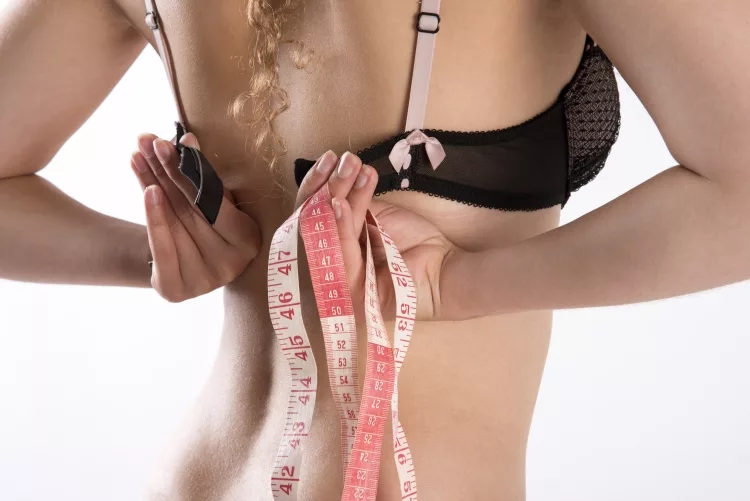
- Wrap a soft measuring tape snugly around your ribcage, directly under your bust.
- Keep the tape level all the way around — it should run parallel to the floor.
- If the measurement lands on an even number, that's your band size. If it's odd, round up to the nearest even number.
- A correctly fitting band should feel firm. You should be able to slide two fingers underneath it, but it shouldn't shift or ride up when you move.
This is the step most women get wrong. The band provides approximately 80% of a bra's total support — a band that's too large transfers all that load onto your shoulder straps, which causes the neck and shoulder pain many women associate with larger busts. Getting this number right before anything else is essential.
Calculating Your Cup Size
Cup size is the letter — A, B, C, D, DD, and beyond. To calculate yours:
- Measure around the fullest part of your bust, keeping the tape slightly relaxed (not pulled tight).
- Subtract your band measurement from your bust measurement.
- Each inch of difference corresponds to a cup size: 1 inch = A, 2 = B, 3 = C, 4 = D, 5 = DD, 6 = DDD, and so on.
One thing worth understanding is that cup sizes are relative to band size — a 32D and a 38D have very different cup volumes despite sharing the same letter. This is the concept of sister sizing: a 34DD, a 32E, and a 36D all hold roughly the same volume of breast tissue. If a style feels almost right but the band or cup is slightly off, trying a sister size often closes the gap.
The Real Cost of Wearing the Wrong Bra Size
Why a Good Fit Matters More Than You Think
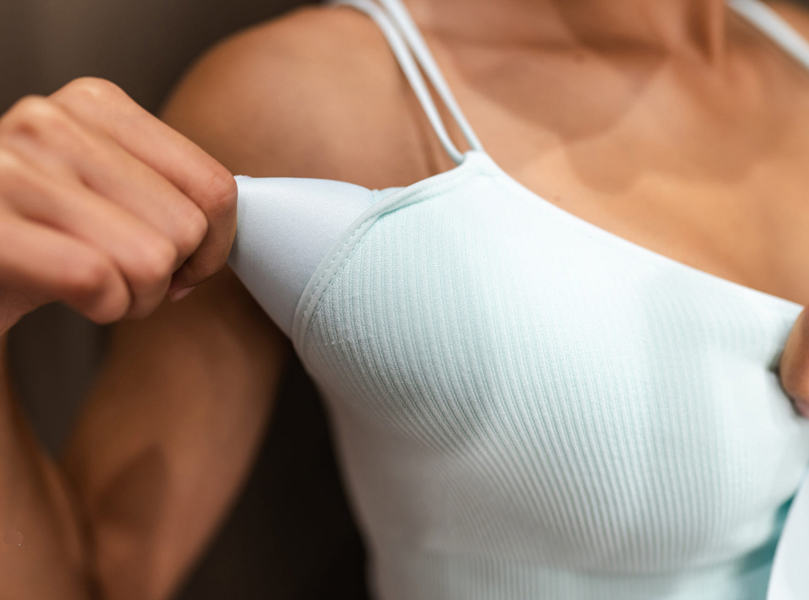
Wearing the wrong bra size isn't just an inconvenience. Over time, a poor fit creates real physical consequences. Chronic back pain, shoulder tension, skin irritation, and postural issues are all commonly linked to ill-fitting bras, particularly when the cup is too small or the band is too loose. For women with larger breasts, inadequate support compounds through the day in ways that can feel exhausting.
A well-fitting bra, by contrast, delivers several benefits most women don't experience until they finally get sized correctly:
- Distributes breast weight across your torso rather than concentrating it on your shoulders
- Keeps breast tissue properly positioned, which matters both for daily comfort and long-term skin support
- Makes clothing fit more smoothly — a properly fitted bra changes how tops, dresses, and jackets hang
- Reduces friction and chafing from straps that dig in or bands that shift
If you've been searching for guidance on support specifically, the article on which type of bra is good for heavy breasts breaks down the styles and features that make the biggest difference.
Pro tip: If your bra straps are doing all the heavy lifting, your band is probably too large — tighten the band size first before adjusting straps, and you'll immediately reduce the pressure on your shoulders.
Signs You're Wearing the Wrong Size
Many women wear the wrong size for years because the discomfort becomes background noise. Here are the clearest signals that your current bra isn't the right fit:
- Band rides up your back — the band is too large and has lost its anchor point
- Cups gap or pucker at the top — the cup is too large for your shape or projection
- Underwire digs into breast tissue at the sides — cup is too small; tissue is being pushed out of the cup
- Straps constantly slip off your shoulders — the band is too large, which causes the back to ride up and pull straps inward
- Double-bubble effect at the top of the cup — a clear sign the cup size is too small
- Red marks along your ribcage or shoulders at the end of the day — indicates excessive pressure from an ill-fitting band or straps
If two or more of these sound familiar, a remeasure is overdue. The fix is usually simpler than expected — often just a band size down or a cup size up.
When to Get Remeasured — and When to Wait
Life Changes That Affect Your Bra Size
Your bra size isn't fixed for life. It responds to your body, which changes across time and circumstance. Some of these changes are gradual; others are sudden. The situations that most commonly trigger a real shift in fit include:
- Weight changes of 10 pounds or more — both gain and loss affect band circumference and cup volume
- Pregnancy and breastfeeding — breast tissue changes substantially at each stage, and your post-nursing size may differ from your pre-pregnancy size
- Hormonal shifts — starting or stopping hormonal birth control, perimenopause, and menopause all affect breast tissue density and size
- Breast surgery — augmentation, reduction, reconstruction, or mastectomy requires a complete refitting, ideally with a specialist familiar with post-surgical bodies
- Significant changes in posture or upper body muscle tone — increased back muscle from strength training, for example, changes how a band fits around the torso
As a practical rule, getting remeasured once a year makes sense even without dramatic physical changes. Bra elastic stretches with regular wear and washing, and your body shifts subtly even when nothing obvious has happened.
When Your Current Size Is Still Working
You don't need to run out for a fitting every few months if your current bras are genuinely comfortable and supportive. Hold off on remeasuring when:
- Your weight has been stable for the past year or more
- No major hormonal events have occurred recently
- Your bras are still fitting on the middle hook — not riding up, not overly snug
- You're not experiencing any of the discomfort signs listed in the previous section
The middle-hook rule is a useful benchmark. A new bra should fit comfortably on the loosest hook, giving you room to progress to tighter hooks as the elastic naturally relaxes with wear. If you're already maxed out on the tightest hook, it's time for a replacement — in the same size or a slightly smaller band — rather than continuing to stretch a bra past its working life.
Practical Tips for Finding and Wearing Your Best Fit
Shopping Smarter Across Brands
One of the most frustrating realities of bra shopping is that sizing isn't standardized across manufacturers. A 34DD from one brand may fit nothing like a 34DD from another — the cup depth, wire width, band stretch, and strap placement all vary. Your "correct" size can shift by a cup or even a band depending on where you shop, which is why treating the label as a starting point rather than a fixed answer tends to work better.
A few strategies that actually help:
- Always try before you buy when possible, or shop with brands that offer free returns and easy exchanges
- Read brand-specific fit guides, particularly for extended sizes — many brands publish detailed notes on how their sizing runs
- Don't dismiss a style just because the label looks different from your usual size; if it fits your body, it's the right size
- Consider whether a bralette versus a traditional bra suits the occasion — they fit quite differently and suit different body types and levels of support needed
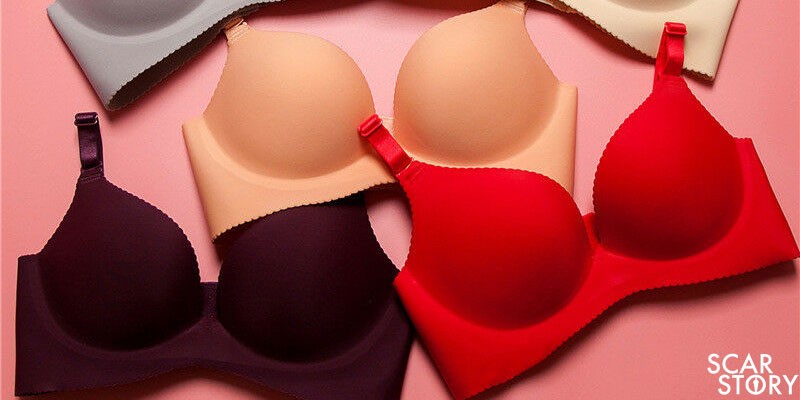
- Pay attention to cup shape: a plunge, a balconette, and a full-coverage bra will all feel different in the same labeled size because they distribute breast tissue differently
Everyday Habits for a Better Fit
Finding the right size is step one. Keeping your bras in good condition so they continue fitting well over time is step two. A few consistent habits make a meaningful difference:
- Rotate your bras — wearing the same bra on consecutive days doesn't give the elastic time to recover its shape. A rotation of at least three to five bras extends the life of each significantly.
- Hand wash or use a mesh lingerie bag — machine washing without protection degrades elastic and underwire channels faster than hand washing, even on delicate cycles.
- Store bras stacked cup-to-cup, not folded in half — repeated folding crushes the molded cup shape over time.
- Replace bras every six to twelve months with regular use — stretched elastic looks intact but no longer delivers the support it once did. A bra that's past its working life is contributing to the discomfort you think is just normal.
For occasions when a traditional bra isn't practical — backless styles, plunging necklines, or simply days when you want minimal coverage — exploring options like nipple covers and breast petals gives you a comfortable, low-profile alternative worth keeping on hand.
Next Steps
- Measure yourself today. Grab a soft measuring tape, find a quiet few minutes, and calculate your current band and cup size using the method above. Compare the result to what you're currently wearing — you may be surprised how far off the label is.
- Do the middle-hook test on every bra you own. Any bra that's already maxed out on the tightest hook, shows visible band stretch, or causes discomfort after an hour of wear should be set aside. It's not giving you the support you think it is.
- Try one sister size. If your current size feels close but not quite right — band slightly loose, cups slightly snug — go one band size down and one cup size up. You might find the fit you've been missing without buying a completely different size.
- Book a professional fitting. Most lingerie boutiques and department stores offer free fittings with no purchase required. A trained fitter often spots nuances that measurements alone miss, especially if your shape is asymmetrical or you're between sizes.
- Shop by fit, not by label. The next time you try on a bra that feels genuinely comfortable and supportive, buy it — even if the label says something different from what you expected. The right bra is the one that works for your body, not the one that matches your mental model of your size.



About Paulette Leaphart
Paulette Leaphart is a breast cancer awareness advocate and writer whose personal journey through diagnosis, treatment, and recovery shapes everything published on this platform. After experiencing the physical and emotional toll of breast cancer firsthand, she dedicated herself to creating a space where women can find honest information, community, and encouragement — covering beauty and personal care for people navigating treatment, fashion and style resources for survivors, and wellness content rooted in real lived experience rather than clinical distance.
About the Author

It's me Emily MacKenzie tried to make a documentary film about breast cancer according to the experience of Paulette Leaphart. Now it is no longer possible for some reason. But I'm not disappointed and I'm very hopeful that I can do something very positive that brings awareness to the women of the devastating disease ''Breast cancer". Just stay with me and keep supporting this platform; you will get update time to time and can know everything about ''Breast Cancer''.
You can get FREE Gifts. Or latest Free phones here.
Disable Ad block to reveal all the info. Once done, hit a button below